The charge never appears when you buy the label. It appears three weeks later, on an invoice line most store owners have never opened, under a heading like Address Corrections. By then the parcel has been delivered, the customer is perfectly happy, and the money is gone.
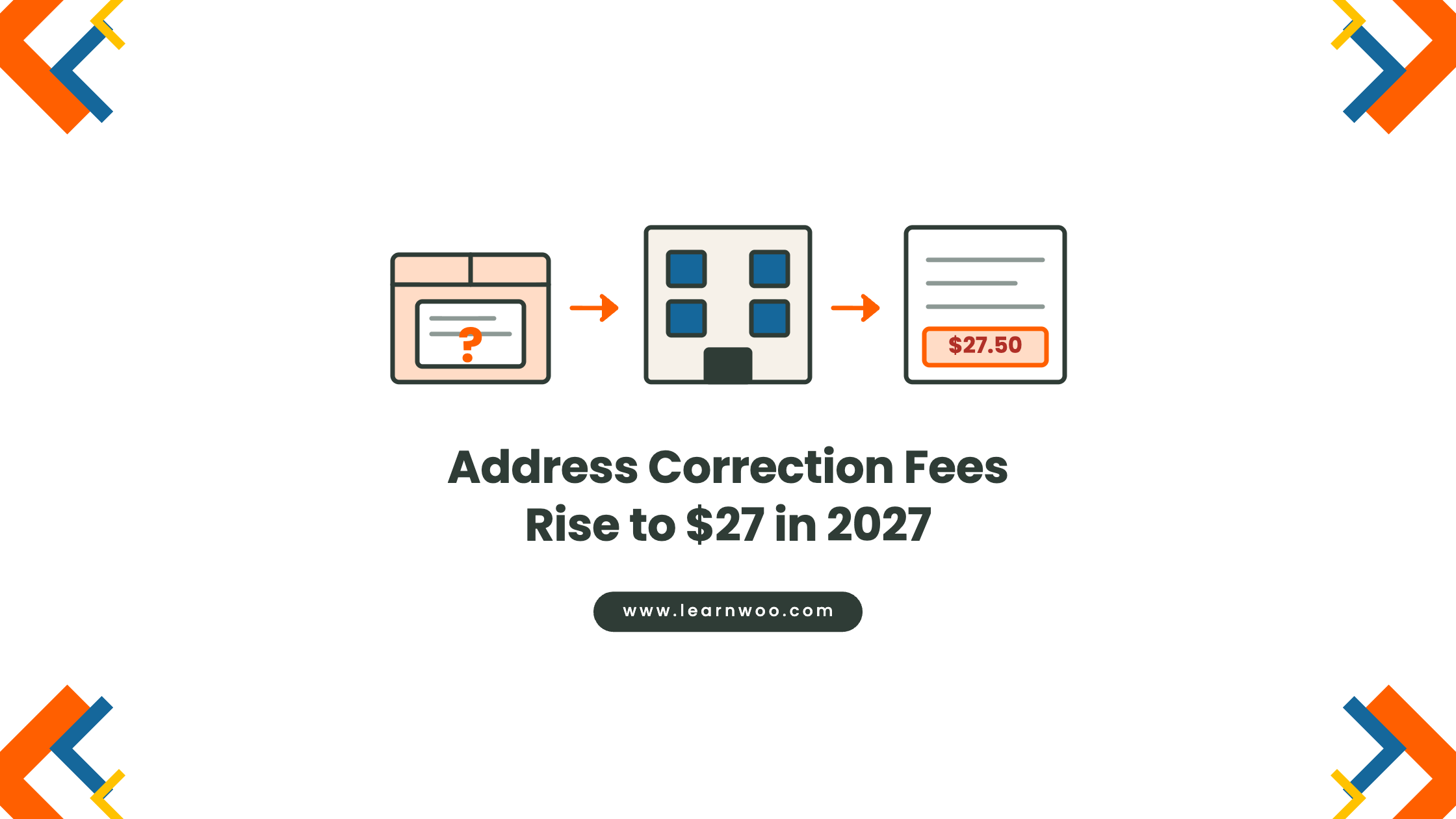
From 21 December 2026, that line gets more expensive. UPS is raising its address correction fee from $25.25 to $27.50 per package as part of its 2027 general rate increase. FedEx follows on 4 January 2027, moving from $25.50 to $27 per correction. It is one of the few peak-season costs that is almost entirely preventable — and it is usually caused by a single missing field at checkout.
Quick answer
An address correction fee is what UPS and FedEx charge when they have to research and fix a delivery address you supplied. It is billed to the shipper, per package, after the parcel has already been delivered. UPS goes to $27.50 on 21 December 2026; FedEx goes to $27 on 4 January 2027. USPS has no equivalent per-package fee — it returns the parcel instead. The fix is to confirm at checkout that an address is a real delivery point, not merely that it is correctly formatted.
What an address correction fee actually pays for
When a driver or a sorting facility cannot deliver because the address is incomplete, wrong or ambiguous, UPS and FedEx do not simply send the package back. They research the correct address against their own delivery databases, sometimes phone the recipient, update the record and deliver it anyway. The fee pays for that work.
Three things about it catch people out:
- It is billed to the shipper, never the recipient. The customer who left out their apartment number pays nothing and hears nothing about it. You absorb the charge silently.
- It is charged per package, not per order. A three-box shipment to one bad address can be corrected three times. UPS does cap it per shipment — its published 2026 tables put the maximum at $175.25 — but that ceiling is far above what a typical parcel shipper ever reaches.
- It is charged even when delivery succeeds. This is why the fee is invisible. Nothing in your store, your tracking page or your customer’s experience signals that a correction happened. The only trace is on the invoice.
What changes, and when
| Carrier | 2026 fee | 2027 fee | New price starts |
|---|---|---|---|
| UPS | $25.25 per package | $27.50 per package | 21 December 2026 |
| FedEx | $25.50 per correction | $27.00 per correction | 4 January 2027 |
| USPS | No equivalent per-package correction fee for parcels | Undeliverable parcels are returned instead | |
The 21 December problem nobody is flagging
Almost every write-up of these increases files them under “2027 rates”, which the brain reads as January. FedEx’s genuinely is January. UPS’s is not.
UPS’s new schedule goes live on 21 December 2026 — four days before Christmas. By then your Ground cut-off has passed, but you are still shipping the messiest parcels of the year: expedited rescues, replacements for lost packages, re-ships to addresses a customer corrected over email, and orders where someone in support retyped an address by hand. Those are precisely the shipments most likely to need a correction, and from 21 December they are corrected at the higher price.
One honest caveat: neither carrier’s published documents state whether a correction performed in January on a package tendered in December is rated at the old price or the new one. The straightforward reading of “effective 21 December” is that the schedule in force on the ship date applies. If you see an amount you cannot reconcile, that is a fair question for your account representative rather than something to guess at.
Why most “address validation” does not prevent this
Here is the misunderstanding that costs stores the most money: formatting an address correctly is not the same as confirming it can be delivered to.
Most checkout address tools do one of two jobs. Autocomplete widgets (Google Places and similar) help the customer type faster and return a tidy, well-formed address. Standardisation tools normalise abbreviations, fix the city-state-ZIP relationship and uppercase everything. Both produce an address that looks perfect. Neither necessarily confirms that mail is actually delivered to that exact point.
The US postal system draws the distinction explicitly through Delivery Point Validation, the data layer behind CASS-certified validation and the free USPS Addresses API. A DPV check returns a confirmation code, and the codes are not simply pass or fail:
That D case is the whole game. The street exists, the building exists, the postcode agrees, your checkout accepts it, your label prints — and then a driver stands in a lobby with forty mailboxes and no unit number, and UPS charges you $27.50 for working out which one.
What actually triggers a correction
How to stop paying it
In rough order of how much money each step saves:
- Validate at checkout, not at label time. Catching a bad address while the customer is still on the page costs you one extra field. Catching it in the warehouse costs you a support email, a day of delay, or the fee. The USPS Addresses API is free with a USPS developer account for US addresses; Google’s Address Validation API, Smarty, Lob and EasyPost all cover the same ground commercially and add international coverage.
- Read the result, do not just call the API. This is where most implementations fail. If the response is D, do not silently accept it and do not block the order — prompt: “This building has multiple units. Which apartment or suite?” One field, shown only when it is needed.
- Re-check before the label prints. Addresses edited by support staff, pulled from marketplace feeds or imported from a CSV never pass through your checkout validation at all. A second check at fulfilment catches them.
- Reject PO Boxes for carriers that cannot serve them. If the chosen shipping method is UPS or FedEx and the address line matches a PO Box pattern, say so at checkout and offer a postal service instead.
- Reconcile your invoices. Almost nobody does this. Pull three months of carrier invoices, filter to the address-correction lines, and count. If the number surprises you, you have just found the business case for steps one to four.
- Dispute the ones that are not yours. Corrections applied to addresses that were in fact complete and deliverable can be challenged, but carrier agreements impose short windows for raising invoice disputes. Check your own contract for the deadline and raise them in batches.
If you are on WooCommerce
WooCommerce core does not verify addresses. It checks that a postcode matches the expected pattern for the selected country and that required fields are not empty — useful, but a long way from delivery-point confirmation, and its own documentation does not describe any built-in address-verification feature. You are either adding a plugin or writing the integration.
On the classic checkout, the woocommerce_after_checkout_validation action is the natural place to call a validator and add a notice. On block checkout the model is different — validation runs through the Store API and the checkout data store rather than a PHP form post, and extra fields are registered server-side. If you have not worked with that split before, our walkthrough of adding custom checkout fields to WooCommerce block checkout covers the mechanics.
Whichever route you take, resist the temptation to hard-block. An address that fails validation is sometimes a brand-new build that the postal database has not caught up with. Warn, offer a corrected suggestion, let the customer override — and flag the order for a human look.
What it costs if you do nothing
It is worth viewing this alongside the other charges landing on the same invoice. Peak season surcharges are already stacked on every parcel through the holidays, and if your cartons are oversized for their contents, dimensional weight pricing is quietly adding to the base rate too. Address corrections are the one line on that list you can take to zero.
Common mistakes
- Treating autocomplete as validation. A Google Places lookup returns a well-formed address. It does not promise a carrier delivers there, and it will cheerfully return a building without its unit number.
- Making “Address line 2” optional and leaving it at that. An empty optional field tells you nothing. A prompt triggered by a D result tells you exactly who needs to supply a unit number.
- Validating only on the storefront. Orders from marketplaces, phone orders and manual admin edits bypass checkout entirely and are over-represented in correction fees.
- Hard-blocking on a failed check. New construction, recently renumbered streets and rural routes all produce false negatives. Blocking turns a $27.50 fee into a lost order.
- Never opening the invoice. The fee is designed to be invisible at the point of shipping. If you do not reconcile, you will not know your correction rate — and you cannot improve what you do not measure.
Advanced notes and limits
USPS works differently. It has no per-package correction surcharge for parcels. Under the Domestic Mail Manual, mail that is undeliverable as addressed is forwarded, returned to sender or treated as dead mail, endorsed with the reason — including Insufficient Address for a piece missing a number, street or box number where the correct address is not known. Cheaper on paper, but you lose the sale’s timing entirely and often the outbound postage, which during peak is the worse outcome.
International shipments are a separate problem. A bad international address can trigger a correction fee, but it can equally stall in customs and generate clearance or brokerage charges that dwarf it. Validation coverage outside the US is also patchier: DPV is a US postal dataset, and non-US addresses are validated against different, generally less granular sources.
The delay is not always refundable. A corrected package typically arrives a day or two late. Whether that delay qualifies for a service guarantee refund depends on your carrier agreement, and delays attributable to shipper-supplied information are commonly excluded. Read your own contract rather than assuming.
Validation is not a fraud control. A DPV-confirmed address can still be a drop address used in card fraud. Address verification and fraud screening answer different questions, and passing one says nothing about the other.
Frequently asked questions
Can I pass the address correction fee on to the customer?
Technically you could, but you will not find out about the charge until weeks after delivery, long after you have taken payment. Collecting it then means a second charge for a parcel the customer already received — a near-certain dispute. Preventing the fee is cheaper than recovering it.
Does the fee apply if the package is delivered successfully?
Yes. The fee pays for the research the carrier did, not for a failed delivery. A successfully delivered parcel is exactly the case where the charge goes unnoticed.
Will shipping with USPS avoid it?
You avoid this particular surcharge, because USPS does not levy an equivalent per-package correction fee on parcels. You do not avoid the underlying problem: an undeliverable parcel comes back to you instead, which during the holidays usually means a refund and a lost customer.
Is the USPS address API really free?
The USPS Addresses API is available at no cost with a USPS developer account for US addresses, subject to USPS’s own usage terms. Commercial providers charge, and what you are buying from them is typically international coverage, higher throughput, a nicer front-end component and support — not better US data, since CASS-certified providers all work from the same postal source.
How do I find these charges on my invoice?
On UPS invoices look for an Address Correction line item against individual tracking numbers, usually grouped into its own section. On FedEx invoices it appears as an Address Correction surcharge on the shipment detail. Both are easiest to find by exporting the invoice detail to CSV and filtering the charge-description column.
What to do this week
You have until 21 December before UPS’s new price applies, and the holiday volume that produces most corrections has not peaked yet. The highest-value hour you can spend is not implementing anything — it is measuring. Export your last three months of carrier invoice detail, filter to the address-correction lines, and divide by packages shipped. That one number tells you whether this is a rounding error for your store or a four-figure annual leak.
If it is the latter, add a DPV-aware check at checkout and act on the D result specifically. It is a smaller project than it sounds, and it is the rare peak-season fix that keeps paying after the season ends.
While you are in the shipping settings, it is worth confirming your cut-off dates against the carriers’ published 2026 holiday shipping deadlines — and if you are bracing for January, our look at how return fees are landing with shoppers covers the other side of the peak-season bill.