Every few weeks, another headline announces that AI agents are about to buy things on your behalf. Meanwhile, the store owner reading that headline has a practical question nobody seems to answer directly: do I need to do anything, and if so, what?
2026 has given us an unusually clear answer, because this is the year agentic commerce ran its first real experiment in public — and one of the most hyped pieces of it was switched off. This guide explains what actually happened, what the competing standards really do, what shipped for WooCommerce stores this month, and the specific work that is worth doing now.
The quick answer
AI agents are sending real, fast-growing traffic to stores, but almost none of them are completing purchases inside the AI itself. Agent-driven checkout collapsed in early 2026; agent-driven discovery is thriving. So the highest-return work right now is making your store legible to AI agents — clean structured product data, crawlable content, accurate stock and policy pages — not rushing to implement a checkout protocol.
What “agentic commerce” actually means
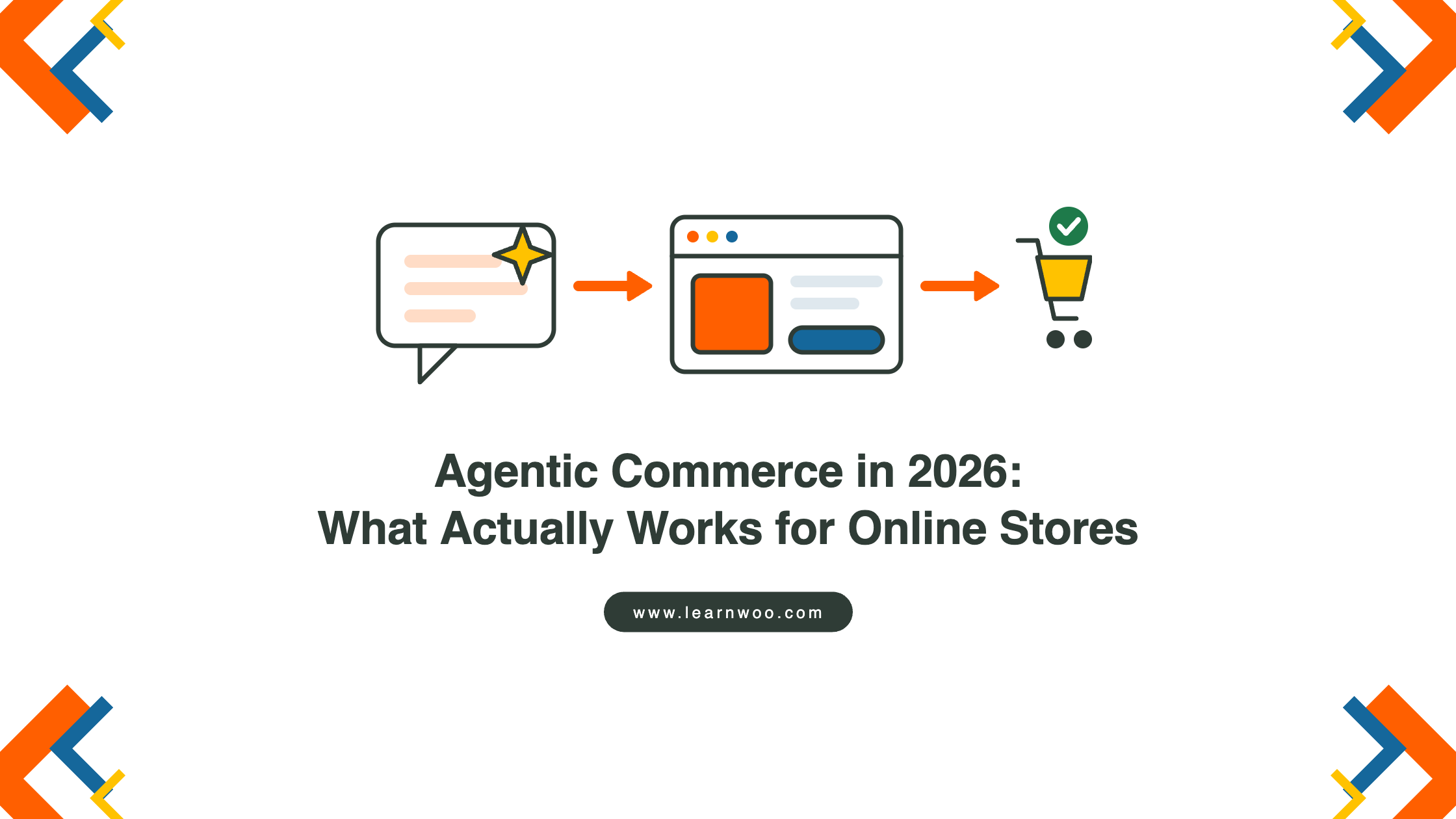
Agentic commerce is any transaction where an AI agent acts on a shopper’s behalf rather than simply showing them a link. It is usually described as a four-stage lifecycle:
- Discovery — the agent finds candidate products and compares them.
- Authorization — the shopper approves what the agent may buy, and within what limits.
- Payment — the agent presents credentials the merchant and payment network can trust.
- Fulfilment — the order enters the merchant’s normal systems and ships.
The important thing for store owners is that these four stages are not advancing at the same speed. Discovery is mature and growing quickly — we covered that shift in detail in our guide to how AI is changing product discovery. Authorization and payment are still contested, half-built, and split across competing standards. That imbalance explains almost everything that happened this year.
The reality check: what happened to in-chat checkout
The clearest lesson of 2026 came from the most prominent experiment in the category.
OpenAI launched Instant Checkout on 29 September 2025, letting shoppers buy selected retailers’ products without leaving ChatGPT. On 4 March 2026 — roughly five months later — OpenAI pulled back from it. An OpenAI spokesperson framed the change as a move rather than a retreat: “Instant Checkout is moving to Apps, where purchases can happen more seamlessly.” Later that month the company rebuilt its shopping experience around product discovery and retailer apps such as Instacart, Target and Expedia.
The adoption numbers explain why. Despite Shopify enrolling a very large merchant base, reporting at the time indicated that only around a dozen merchants ever went live with in-chat checkout. Shopify president Harley Finkelstein pointed to the AI platform side, not merchant reluctance, as the constraint.
The takeaway is not that agentic commerce failed. It is that the checkout layer was the weakest link, and the discovery layer was the strong one — and merchants who spent 2025 preparing their product data rather than integrating a checkout API made the better bet.
The numbers: how much AI traffic is actually real?
Two facts have to be held at the same time here, and most coverage only reports one of them.
Fact one: the growth is extraordinary. Adobe Analytics data reported by Digital Commerce 360 showed AI-referral traffic to US retail sites up 62% year over year in July 2026, and up more than 1,200% against an October 2024 baseline. In May 2026 the year-over-year figure was 138%. Adobe also observed, as of March 2026, that AI-driven traffic converted around 42% more often than traffic from non-AI sources.
Fact two: the base is small. In early 2026, several large online retailers reported that AI referrals still accounted for under 2% of their total traffic referrals. Individual retailers further along the curve — the furniture brand Povison, for example — put it nearer 5%.
So: a channel growing at triple-digit rates, converting better than average, and currently worth low single-digit percentages of traffic. That is a channel worth preparing for deliberately, and a bad reason to re-platform or rebuild your checkout.
Why the conversion numbers disagree across sources
You will find 2026 studies claiming AI traffic converts 42% better, 54% better, and worse than every channel except paid. They are mostly measuring different things: some count only trackable standalone LLM referrers, some include AI-mode search results, and attribution windows vary. Treat any single figure as directional. The one finding that repeats across datasets is that AI-referred visitors arrive later in the buying process than generic search visitors, because the comparison work already happened inside the assistant.
The protocol landscape, explained without the jargon
Much of the confusion in this space comes from four acronyms that are frequently discussed as if they compete. Mostly they do different jobs.
| Standard | Backed by | What it governs | Matters to you if… |
|---|---|---|---|
| ACP Agentic Commerce Protocol |
OpenAI & Stripe | Chat-to-buy: an agent builds a cart and checks out inside the AI surface | You are a large retailer with an app-style integration |
| UCP Universal Commerce Protocol |
Search-to-buy: purchases inside Google’s AI Mode and Gemini, built on Merchant Center feeds | You already run Google Shopping feeds | |
| AP2 Agent Payments Protocol |
Google + payment networks | Trust and mandate: proving an agent was actually authorised to spend | You handle disputes and chargebacks |
| MCP Model Context Protocol |
Anthropic (open) | Plumbing: how an agent connects to your store’s data and tools at all | You are building any agent yourself |
Google’s documentation describes UCP as “an open standard designed for the future of commerce” that is interoperable with AP2, A2A and MCP, and offers merchants two integration routes: native checkout, or an embedded (iframe) checkout for more complex flows. It is still a preview product with a waitlist, currently expanding into lodging and food.
The honest summary for a typical store: none of these require action from you today, and at least one of them will look different in six months. What does not change is the layer underneath all of them — your product data.
What just shipped for WooCommerce
On 16 September 2026, WooCommerce published its adaptation of Anthropic’s open-source Claude Commerce Agent starter code, in its Agentic Tools repository. It is worth understanding precisely, because it is easy to over-read.
It provides two things:
- A shopper assistant that searches your catalogue, builds a cart and answers policy questions. Critically, WooCommerce is explicit that “the assistant never places an order or takes payment. Checkout is still on the store’s own page.” A small bridge plugin hands the cart back to the customer’s normal WooCommerce session.
- A merchant assistant that answers questions about sales, inventory alerts and problem orders, and stages suggested changes — pricing, restocking, copy edits — for a human to approve.
Running it needs Python 3.11+, Node 22 with Next.js, and Docker for a local test store, which spins up a seeded WooCommerce environment with eight products and nine orders in about fifteen minutes.
The limitations are stated plainly by WooCommerce and are the most useful part of the announcement: there is no undo, no durable audit record beyond the conversation, no authentication layer (a developer must add one), keyword-based rather than semantic product retrieval, and analytics capped at the 400 most recent orders. It is described as experimental and unsupported, aimed at “developers and agencies that are evaluating and prototyping AI applications.” Merchants wanting something production-ready are pointed at WooCommerce AI, a separate supported wp-admin plugin with preview, approval and undo. If you are weighing this kind of tooling more broadly, our roundup of AI tools for eCommerce covers the supported end of the market.
Read this as a signal, not a product. The significance of the release is that the reference architecture for store agents now assumes a human-approved, store-hosted checkout and staged merchant changes. That is the opposite of the fully autonomous buying agent the 2025 headlines described — and it matches what actually survived contact with real merchants.
What to actually do now: a seven-step readiness checklist
Everything below is work that pays off regardless of which protocol wins, because every agent — ChatGPT, Gemini, Claude, Copilot, a comparison bot — needs the same underlying facts about your products.
1. Fix your structured product data first
Agents parse Product, Offer and AggregateRating schema before they parse your prose. Confirm each product page emits valid schema with price, currency, availability, GTIN/MPN where applicable, and shipping details. WooCommerce outputs much of this natively; SEO plugins often duplicate or conflict with it, so validate a few real URLs rather than assuming. This overlaps heavily with answer engine optimization, which is worth reading alongside this checklist.
2. Make availability and price accurate in real time
An agent that recommends an out-of-stock product creates a support ticket and a lost customer. If your stock sync runs on a long cron interval, shorten it, and make sure your inventory management setup reflects reality rather than yesterday’s snapshot. This matters more in agentic discovery than it ever did in classic SEO, because the agent quotes your data as fact.
3. Write policy pages an agent can quote
Shipping times, returns windows, warranty terms and international restrictions should exist as plain, specific text on dedicated pages — not buried in an accordion, a PDF, or an image. “Most orders ship within 1–2 business days” is answerable. “Fast shipping!” is not.
4. Decide deliberately which AI crawlers you allow
Check your robots.txt and any bot-blocking at the CDN or firewall layer. Many stores blocked AI user agents in 2024–25 to protect content, and are now invisible in exactly the channel growing fastest. This is a business decision, not a technical default — make it on purpose.
5. Keep your Merchant Center feed clean
Google’s UCP builds on existing Merchant Center shopping feeds. If your feed is already accurate and complete, you are largely pre-positioned for search-to-buy without doing anything protocol-specific.
6. Start measuring AI referrals separately
Create a channel grouping or segment in your analytics for known AI referrers so you can see this traffic’s real size, conversion rate and AOV for your store, rather than arguing from someone else’s benchmark. You cannot make a sensible investment decision at 0.4% of traffic or at 6% without knowing which one you are.
7. Only then evaluate a protocol integration
If steps 1–6 are done and AI referrals are material for you, look at UCP’s waitlist if you are feed-led, or ACP if you are large enough to run an app-style integration. For most independent stores, that decision belongs in 2027.
Common mistakes
- Treating one benchmark as your forecast. A 42% conversion uplift on 1.5% of traffic is not a mandate to rebuild anything.
- Blocking AI crawlers by accident. A blanket bot rule added for scraping reasons frequently removes a store from AI-assisted discovery entirely.
- Chasing protocol announcements. Ten-plus agentic commerce protocols were active by mid-2026 with little interoperability. Betting on one early has a real cost and an unclear payoff.
- Letting an agent write to your store without approval. Even WooCommerce’s own reference implementation stages changes for human review — for good reason, since it has no undo.
- Ignoring the support consequences. If an agent quotes an outdated delivery estimate from your site, your team absorbs the complaint.
Advanced notes for developers
If you are building on the WooCommerce agentic tools or a similar MCP integration, three constraints deserve early attention.
Authentication is your problem. The reference code ships without an auth layer. Any production deployment needs scoped credentials, per-session identity, and a hard boundary between shopper-facing and merchant-facing tools — a shopper assistant must never reach an endpoint that can mutate products or read other customers’ orders.
Retrieval quality is the ceiling. Keyword search over a catalogue produces confidently wrong recommendations in categories with overlapping vocabulary. If you are prototyping, replacing keyword retrieval with an embedding-based index over product titles, attributes and descriptions is usually the single largest quality improvement available.
Build the audit trail you will need later. Conversation history is not an audit record. Log every staged and applied change with actor, timestamp, before/after values and the conversation ID. You will want this the first time a price is wrong, and you will want it before any payment-layer protocol arrives, because AP2-style mandate verification assumes you can prove what was authorised.
Frequently asked questions
Can AI agents buy from my WooCommerce store today?
Not autonomously, in the mainstream assistants. They can find your products, compare them and send a shopper to your checkout. In-chat purchase flows are currently limited to large integrated retailers through app-style integrations.
Is ChatGPT Instant Checkout coming back?
Not in its original form. OpenAI moved purchasing into Apps in March 2026 and continues developing ACP with Stripe, but with a narrower focus on large integrated retailers.
Do I need a plugin for agentic commerce?
No. The prerequisites are data quality, crawl access and accurate policy content. Agent plugins are useful for building an on-site assistant, which is a different project from being discoverable by external agents.
Should I block AI crawlers to protect my content?
That is a legitimate choice for publishers. For a store selling products, blocking the crawlers that feed AI product discovery removes you from a channel growing at triple-digit rates. Most merchants should allow product and category URLs at minimum.
How do I tell AI referral traffic apart from normal referral traffic?
Filter on referrer hostnames for the major assistants and AI search surfaces, then group them into a custom channel. Expect it to undercount — many AI-influenced visits arrive with no referrer at all, because the shopper typed or pasted your name.
Where this leaves you
The agentic commerce story of 2026 is not the one that was predicted. The autonomous buying agent got smaller; the AI research assistant that sends pre-qualified shoppers to your own checkout got much bigger. The second of those is entirely addressable with work you can start this week, and none of it is wasted if the protocols shift again.
Start with the structured data audit in step one. It is the least glamorous item on the list and the one that every other layer depends on.