Last updated - September 14, 2026
Growing a WooCommerce marketplace can be quite different from running a regular online or offline store. A traditional store would only need to attract customers and increase sales.
But a WooCommerce marketplace needs to achieve both simultaneously! At the same time, a marketplace needs to satisfy two audiences:
- buyers who are looking to buy good-quality products
- and vendors who are looking to sell in a marketplace at good profits.
This is an interesting challenge that you’d have to solve. You need enough vendors to compile a collection of good-quality products to entice your customers. But at the same time, vendors are more prone to sell in stores where an existing customer base may already exist. Breaking this cycle is how you grow your marketplace.
So how do you solve this?
The initial approach would be to tackle each issue one by one. First and foremost is making vendors feel important and like your store is where they need to be selling. At the same time, keeping customers satisfied is crucial as well. But the most essential aspect is ensuring that data is compiled from both aspects to understand which sides need work and how extensively.
Let’s look at 12 proven strategies on how to grow a WooCommerce Marketplace.
12 Proven Strategies to Grow Your WooCommerce Marketplace
1. Make It Easy for Vendors to Join and Start Selling
The first step in creating your WooCommerce marketplace is having a Vendor onboarding process. This process is crucial because it can either make or break your business.
If the onboarding process is straightforward, it ensures that most vendors will come join in. However, if your vendor onboarding process is complicated and has lots of unnecessary steps, then you will be struggling to find vendors to sign up for your store.
Make the process as straightforward as possible. The workflow should look something like this;
Create a dedicated “Become a Vendor” or “Sell with Us” page that explains who can sell, marketplace fees or commissions, payout schedules, product requirements, shipping expectations, and how approval works.

Only ask for information you genuinely need at the beginning. Additional information can be collected after the vendor is approved as well.
Once your vendors are approved, don’t let go easy. Make sure that the process continues. Provide them with a checklist for completing the setup of their store, uploading products, configuring shipping, and making their first sale.
2. Recruit the Right Vendors
A marketplace with a 1000 sellers but no sales is not better than one with 100 sellers and some sales occurring. Even in sales, quality always matters over quantity.
Building your own WooCommerce marketplace entails that you must choose the right vendors. You need to choose vendors who add value to your business, something unique and irreplaceable. The uniqueness of your sellers is what helps ensure that customers are interested in your brand. Qualities that you can search for in sellers include: strong customer service, competitive pricing, or expertise in an important category.
Start by identifying gaps in your catalog.
For example, your customers are constantly searching for “linen clothes“, but your store only has two sellers who provide these products. Once you have identified this need, you can search for vendors who fit this category.
Use your internal search data, customer requests, sales data, competitor research, and category performance to decide whom to approach.
Prioritizing vendors with products customers cannot easily find elsewhere can also create stronger differentiation. Focusing on bringing vendors that cater to your customers’ requirements and align with the marketplace is a much better strategy than trying to maximise the number of sellers you have. By being intentional about the sellers in your WooCommerce marketplace, you can ensure that your store caters to your customers, ensuring their return!
3. Help Vendors Make Their First Sale and Stay
Once you’ve gotten vendors to sign up, there’s more work to be done. Part of running a WooCommerce marketplace is supporting sellers in making their first sale.
Onboarding vendors is half the process. The rest includes ensuring that they remain part of your store and maintain exclusivity.
A vendor who joins, uploads two products, gets no sales, and leaves doesn’t contribute much to marketplace growth. Your goal should be to move vendors from registered to active to successful.
You can give vendors practical guidance on:
- Completing their store profile
- Adding quality product photos
- Writing useful product descriptions
- Setting competitive prices
- Configuring shipping correctly
- Promoting their products
- Collecting customer reviews
But more than just supporting them, you can also go a step beyond. As sellers, they might be focusing completely on the sales aspect. Instead of showing them numbers internally only, you can even put a spotlight on the promising vendors across social media. Post promising sellers across social media, category pages, and even make it a part of your multi-vendor marketplace marketing strategy, or as part of promotions.

Keep an eye on metrics such as:
- Active vendor rate: This refers to the percentage of onboarded vendors who are actively listing and selling.
- Time to first sale: The duration it takes for a newly onboarded partner to make their first sale after completing onboarding.
- Vendor churn: The rate at which suppliers or providers stop doing business with a company
- Average products listed per vendor
Successful marketplaces invest in vendor support because vendor churn creates product gaps and forces the marketplace to repeatedly replace sellers.
4. Build Product Pages That Create Trust
Having trusted sellers on your WooCommerce marketplace is bound to get you customers. You may even have customers who are comfortable with your store. But they may be unfamiliar with the individual seller behind a product.
So, you may be wondering why that’s important. But having transparency across your store will teach your customers to trust your store. Your product pages should always strive to close that trust gap and provide customers with as much context as needed.
Every listing should clearly show:
- High-quality product images
- A useful, original description
- Price and availability
- Shipping information
- Estimated delivery
- Return information
- Seller name and profile
- Ratings and reviews
Reviews are especially important. 95% of consumers have admitted that they regularly read product reviews, while only 43% said they would purchase a product with zero ratings or reviews. So, the more reviews your products have, the greater success your store will achieve in sales.
So don’t bury reviews at the bottom of the page. Display ratings and review counts where shoppers can easily see them.
You can also introduce marketplace-specific trust signals such as Verified Seller, Top Rated, or Fast Shipping badges, provided vendors actually meet clearly defined criteria.
5. Make Search and Navigation Effortless
As your marketplace grows, finding the right product becomes just as important as adding more products.
Imagine a marketplace with 10,000 listings but poor search functionality. Customers may know exactly what they want but still struggle to find it.
So, the best thing you can do is improve product discovery. There are several ways for you to achieve this.
You can improve product discovery with:
- Search autocomplete
- Relevant search results
- Filters by price, category, brand, vendor, and attributes
- Product sorting
- Breadcrumb navigation
- Related products
- “Customers also bought” recommendations
These ways can ensure that customers can find your products with ease.
While running a store, as important as it is to make sure that the best products get recognition, you must look out for searches that return zero results. This is so that you know what customers want and are unable to find.
Finding this niche can be a breakthrough for your marketplace. You can find sellers that sell products according to the customers’ requirements in those specific niches.
Search data can also help your vendor acquisition strategy. A repeated search with few matching products tells you where new supply could create immediate value.
6. Optimize Your Marketplace for SEO
SEO can bring in buyers who are already searching for the products or categories you offer.
WooCommerce itself recommends SEO as a way to attract relevant traffic without paying for every visit.
For a marketplace, SEO goes beyond optimizing individual products.
Optimize three important page types:
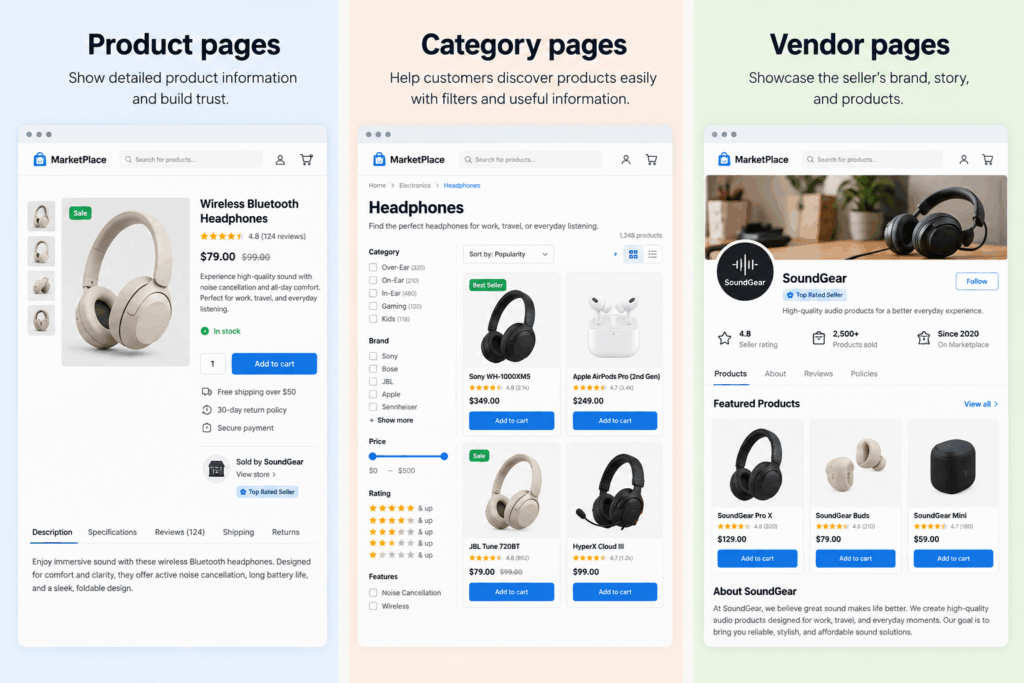
Product pages: Use unique titles, useful descriptions, optimized images, product schema, and internal links.
Category pages: Target real search intent and provide enough useful content to explain what shoppers will find there.
Vendor pages: Give sellers searchable store pages with useful information about their products and specialties.
You should also prevent your marketplace from creating thousands of low-value pages. Duplicate product pages, thin vendor profiles, duplicate filter URLs, and outdated listings can create SEO problems instead of more traffic.
The goal isn’t to have the largest number of indexed pages. It’s to have the largest number of useful pages that satisfy real searches.
7. Use Content Marketing to Attract Buyers and Vendors
Your blog shouldn’t exist just to publish “10% off” announcements.
Create content that answers the questions your customers are already asking.
For buyers, that might include:
- How to choose the right running shoes
- Best sustainable home products
- How to choose handmade gifts
- Product comparison guides
- Seasonal shopping guides
For vendors, create resources such as:
- How to sell products on a WooCommerce marketplace
- How to write better product descriptions
- How to price products online
- How to photograph products
- How to improve marketplace sales
This creates two separate acquisition paths:
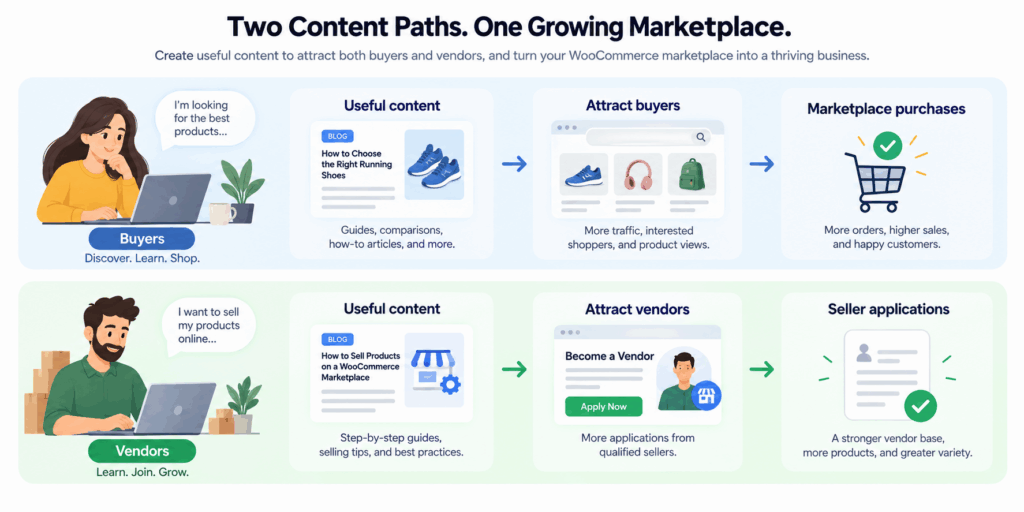
Link relevant articles to your product categories, products, and vendor pages so content becomes part of the customer journey rather than a dead end.
8. Use Email Marketing to Bring Customers Back
Getting the first purchase is important. Getting the second one is even more valuable for long-term growth.
Instead of sending the same newsletter to everyone, segment your customers based on their behavior.
For example:
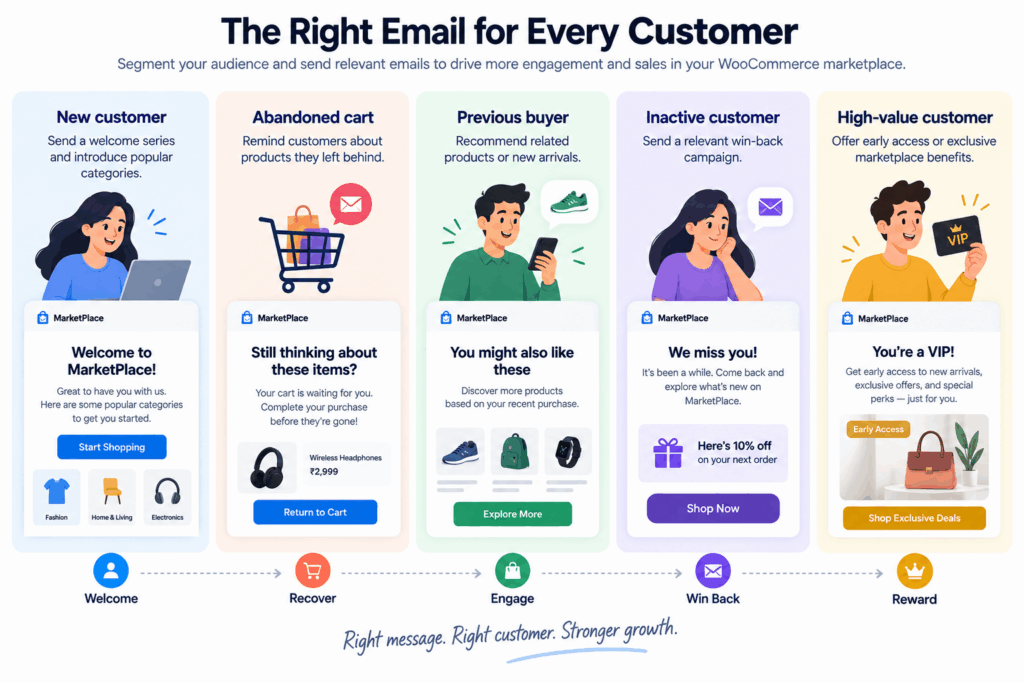
- New customer: Send a welcome series and introduce popular categories.
- Abandoned cart: Remind customers about products they left behind.
- Previous buyer: Recommend related products or new arrivals.
- Inactive customer: Send a relevant win-back campaign.
- High-value customer: Offer early access or exclusive marketplace benefits.
Abandoned carts are particularly worth addressing. Not all of that abandonment can be recovered, but reducing avoidable checkout friction can recover otherwise lost sales.
9. Turn Existing Customers Into Referrals
Your happiest customers can become one of your most effective acquisition channels.
Create a simple referral program that gives both people a reason to participate.
For example:
Earn a $10 discount for every referral!
A customer receives $10 marketplace credit when a friend completes their first eligible purchase.
You can also reward customers for other valuable actions, such as leaving a review or referring a new buyer.
Industry analysis reports that well-designed referral programs can generate 15–30% of new customer acquisition, while referred customers showed higher lifetime value and lower churn in the study. Treat these figures as benchmarks rather than guaranteed results for every marketplace.
For a marketplace, referrals can also work on the supply side. Existing vendors can refer other relevant sellers and receive a commission credit, promotional placement, or another incentive.
10. Use Paid Ads Strategically
Paid advertising can help you generate demand quickly, but it shouldn’t be your only growth engine.
Start with products and categories that already show signs of demand. Your strongest candidates usually have good reviews, competitive pricing, healthy margins, and an established conversion history.
You can use channels such as Google Search Ads, Google Shopping, Meta ads, retargeting campaigns, and dynamic product ads.
The basic process is:
Find → Test → Measure → Scale
Don’t simply increase spending because traffic is increasing.
Track aspects such as :
- Customer acquisition cost (CAC): The total expense a company spends on sales and marketing to win a new customer.
- Conversion rate: Number of people who make a purchase compared with the number of visitors.
- Return on ad spend (ROAS): The revenue you generate based on the amount you spend on ads.
- Customer lifetime value: This refers to the total profit or revenue a business expects to earn from a customer over the entire course of their relationship
WooCommerce identifies paid search, paid social, influencer marketing, SEO, email, and social posting as several ways stores can increase traffic.
For a marketplace, paid campaigns work best when they support proven categories rather than trying to promote everything in the catalog simultaneously. So find your best products and utilize multi-vendor marketplace marketing for your business’ growth.
11. Make Your Marketplace Fast and Mobile-Friendly
A beautiful marketplace won’t grow if it feels frustrating to use.
Mobile optimization deserves particular attention. Most of your customer base would be mobile users.
Test your marketplace on an actual smartphone, not just a desktop browser resized to a smaller window.
Check:
- Product image loading
- Menu navigation
- Search
- Filters
- Add-to-cart buttons
- Checkout
- Payment forms
- Error messages
- Shipping selection
Checkout is particularly important. 7 in 10 ecommerce carts are abandoned, which makes checkout usability one of the biggest opportunities for recovering lost sales.
Removing unnecessary checkout fields would make the process much easier. And allow guest checkout where appropriate. Part of making your WooCommerce marketplace more mobile-friendly is by showing costs clearly and making it easy for customers to correct mistakes.
Don’t forget vendors, either. Their dashboards and product-upload workflows should work smoothly on mobile devices as well.
12. Measure Your WooCommerce Marketplace Growth and Keep Testing
Finally, stop measuring growth with traffic alone. You need data to understand the growth of your store and where are some avenues for growth.
A marketplace needs to understand both sides of its business.
For buyers, track:
Visitors → Product Views → Add to Cart → Checkout → Purchase → Repeat Purchase
For vendors, track:
Vendor Application → Approval → Product Listing → First Sale → Active Vendor
Your core marketplace dashboard should include metrics such as:
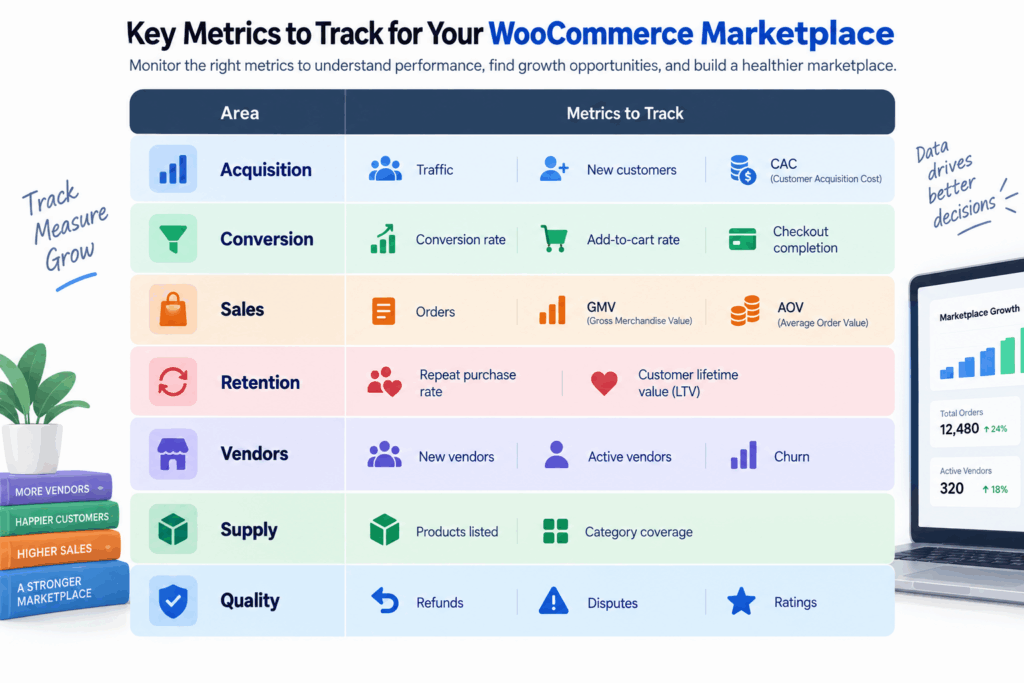
Then test improvements instead of relying on assumptions.
You could test a shorter vendor signup form, a new product-page trust badge, free shipping versus a percentage discount, or two different checkout layouts.
You could work on running focused experiments to measure the result. Based on the results, you could keep the changes that actually improve the numbers.
How to Prioritize These WooCommerce Marketplace Growth Strategies
Now that you’ve understood the 12 strategies that you can employ to grow your WooCommerce marketplace, it’s important to understand how to prioritize as well.
As a store owner, you can’t solve all problems at once, or employ each strategy simultaneously.
The first thing that you should begin with is understanding what problems your marketplace is facing. Based on the analysis of what problems exist, you can utilise the strategies accordingly.
- Not enough vendors?Start with vendor onboarding, targeted vendor acquisition, and vendor support.
- Enough vendors but not enough sales?: You can improve product pages, search, SEO, and checkout.
- Good traffic but poor repeat purchases?: You should focus on email, referrals, and customer retention.
- Growing sales but marketplace growth is slowing?: Focus on improving SEO and content, test paid acquisition, and use your marketplace data to identify new opportunities.
The most important principle is simple. You must fix the bottleneck before adding another growth channel.
Conclusion
Growing a WooCommerce marketplace is not just about marketing your store or getting good sellers. It’s about creating a marketplace that grows as the number of sellers increases. To grow your store, you need to hire good vendors, sell quality products, and deliver a memorable shopping experience. This would ensure that you have consistent customers.
Better vendors → better products → better shopping experience → more buyers → more sales → more attractive marketplace → better vendors.
This loop is how you can create sustainable marketplace growth.
Start by identifying the biggest bottleneck in your marketplace, fix it, measure the result, and then move to the next opportunity. With the right strategies, your WooCommerce marketplace can grow without sacrificing quality along the way.
Frequently Asked Questions (FAQs)
1. How do I grow a WooCommerce marketplace?
Focus on both sides of the marketplace. Recruit quality vendors, make onboarding easy, improve product discovery and trust, attract buyers through SEO and content, and bring existing customers back through email and referrals. Track vendor and buyer metrics separately so you know where growth is getting stuck.
2. How do I attract vendors to my WooCommerce marketplace?
Identify categories where customers want more products and directly approach relevant vendors. Give sellers a clear reason to join, explain commissions and payouts upfront, and keep registration simple. Most importantly, provide enough onboarding support to help them make their first sale.
3. How do I attract customers to a WooCommerce marketplace?
Use SEO, useful content, paid advertising, social media, referrals, and email marketing. Customers also need a strong product selection, trustworthy sellers, easy navigation, competitive prices, and a smooth checkout experience.
4. What metrics should I track for a WooCommerce marketplace?
Track orders, conversion rate, average order value, customer acquisition cost, repeat purchase rate, and customer lifetime value. On the vendor side, track applications, approvals, active vendors, time to first sale, products listed, and vendor churn.
5. What makes a WooCommerce marketplace successful?
A successful marketplace creates value for both buyers and vendors. Buyers get better product selection, convenience, trust, and service. Vendors get access to customers, useful selling tools, reliable payouts, and opportunities to grow their businesses.