Acquiring customers is just half the challenge in the highly competitive arena of e-commerce. Although most companies allocate significant resources to marketing campaigns that attract customers through such channels as advertising, SEO, and social media marketing, they must find customer retention strategies for eCommerce to retain their clients in order to ensure sustainable success.
Customer retention is the process by which a business ensures the continued engagement of its clients by making them purchase from it again. It may be less expensive compared to customer acquisition, and the clients will be loyal, spend more, purchase more frequently, and refer the business to other people.
Some of the most effective eCommerce retention techniques for customers are highlighted below, and these can be used by WooCommerce store owners.
Why Customer Retention Matters in eCommerce
While most online stores emphasize the importance of customer acquisition, sometimes customer retention strategies may be even more profitable for you.
Here are some of the main reasons why customer retention is important:
- It costs more to acquire a new customer than to retain an existing one.
- Existing customers generally purchase more compared to new ones.
- Your loyal customers will refer others to you.
- The value of a customer increases with higher retention rates.
- Your loyal customers will provide you with feedback that will help you improve.
Effective customer retention leads to making customers your brand advocates.
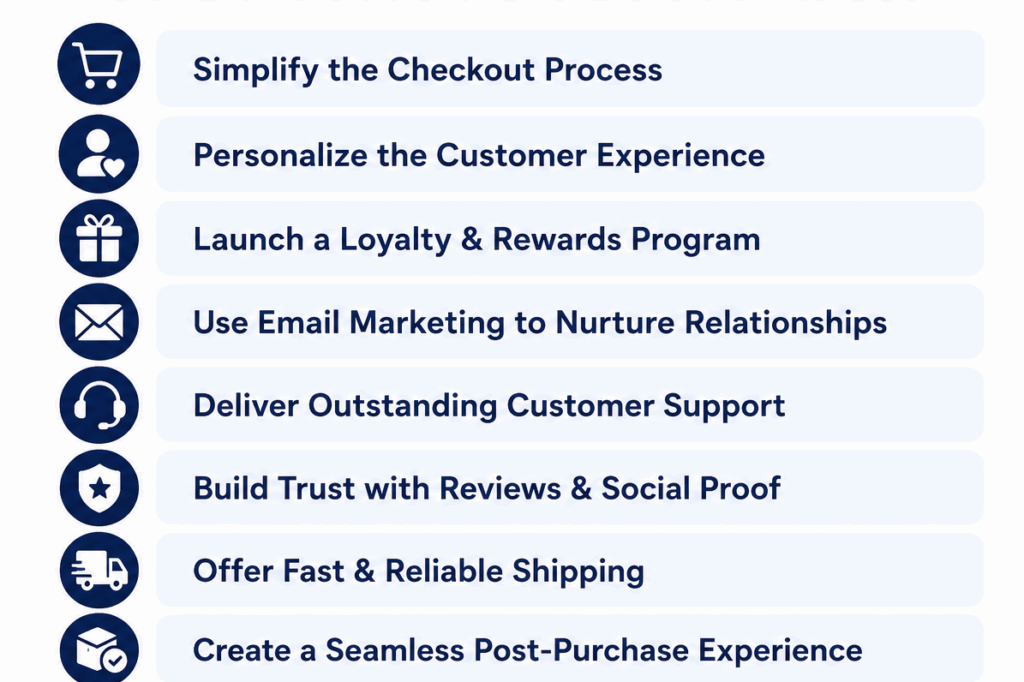
1. Simplify the Checkout Process
A complex checkout process is perhaps one of the most frequent causes of cart abandonment by customers and non-return visits.
Customers who face a large number of form fields, complicated navigation, and required registration may choose to quit the process without making a purchase.
Checkout Optimization Tips
- Provide guests with the ability to check out.
- Eliminate excess checkout fields.
- Provide different methods of payment.
- Indicate shipping prices clearly.
- Increase the speed of your checkout page.
WooCommerce website owners can install some useful plugins that will allow for customizing the checkout process on their website. WooCommerce Checkout Field Editor helps to get rid of unneeded checkout fields
2. Personalize the Customer Experience
Consumers of today love to be treated with personalization. Customers who feel that they are known by the company and how they shop are loyal customers.
Personalization helps one create experiences that matter to the customers.
Personalization Methods
- Make product recommendations based on purchase behavior.
- Display recently visited products.
- Launch personalized email campaigns.
- Provide customized discount codes.
- Serve personalized content depending on the consumer’s interests.
In case a consumer keeps purchasing fitness products, they will benefit from recommendations, thus making them visit again. Personalization ensures that consumers feel appreciated, hence loyalty
3. Launch a Loyalty and Rewards Program
One of the most effective methods for keeping customers in e-commerce is having a loyalty program.
By giving them incentives to stay loyal because of their repeat business, they are guaranteed to be faithful to your store instead of switching to another company.
Some Common Loyalty Program Concepts
- Earn award points with each purchase made.
- Offer discounts depending on points earned.
- Create special deals that only members can enjoy.
- Reward customers for referring others.
- Offer them gifts and rewards on their birthdays.
Customers feel valued and exclusive through a loyalty program, and therefore, keep coming back. For instance, WooCommerce smart coupons simplifies the process of creating, issuing, and managing coupons, credits, and gift certificates.
4. Use Email Marketing to Nurture Relationships
Email Marketing is one of the most effective ways to drive retention for online companies.
Social media algorithms will never give you a chance to talk directly to your customers as email does.
Important Retention Emails
Welcome Email: Introducing your brand and setting the tone for further communication.
Cart Recovery Email: Recovering the sales that you’ve just lost because of customers leaving products in their cart.
Post Purchase Email: Showing gratitude and providing additional information about the product they bought.
Campaigns for Customer Re-engagement: Getting back customers who haven’t purchased anything for a long time.
Services such as AutomateWoo and MailPoet could be used for automating all the above-mentioned types of communication.
5. Deliver Outstanding Customer Support
Superior customer service could set your e-commerce platform apart from other competitors.
The likelihood that customers will return is much greater when they have confidence that your support system will address their concerns.
Customer Support Best Practices
- Be fast in responding to questions.
- Have various means of support.
- Provide live chat options.
- Develop a comprehensive knowledge base.
- Keep policies regarding returns and refunds transparent.
Sometimes there may be difficulties, but a pleasant support experience will help build customer loyalty. Improving customer service will translate into higher customer retention and positive publicity.
6. Build Trust Through Reviews and Social Proof
Trust is an important factor when buying anything online. The buyers expect to buy their products from trustworthy vendors who provide the right products.
Improvement through Review Requests
- Raise the bar in terms of product quality.
- Show that the customers are satisfied with the products purchased.
- Promote community interaction.
- Help in providing constructive feedback on improving further.
Once you sell your product, you should request a review of the purchased product from the buyer automatically.
7. Offer Fast and Reliable Shipping
The shipping experience greatly affects customer satisfaction. Delays, inaccurate tracking information, or broken items can have a negative effect on retention rates.
Best Practices for Shipping
- Estimate delivery accurately.
- Tracking is available.
- Choose reliable shipping providers.
- Be proactive about delays.
- Free shipping thresholds should be considered.
People will be more willing to come back if they realize that your shop always delivers reliably.
WooCommerce provides many different options for shipping and tracking.
8. Create a Seamless Post-Purchase Experience
Customer retention doesn’t end after a sale is completed.
The post-purchase phase presents a valuable opportunity to build stronger customer relationships.
Ways to Improve Post-Purchase Engagement
- Send order confirmation emails promptly.
- Provide shipping updates.
- Share product usage tips.
- Request reviews and feedback.
- Offer complementary product recommendations.
A positive post-purchase experience increases satisfaction and keeps your brand top of mind for future purchases.
9. Engage Customers Through Content Marketing
Content marketing helps build long-term relationships by providing value beyond products.
Educational and informative content positions your brand as an authority in your niche.
Content Types That Support Retention
- Blog articles
- Product guides
- Tutorials
- FAQs
- Video demonstrations
- Case studies
For WooCommerce stores, publishing relevant content can encourage repeat visits and increase customer engagement.
Customers who regularly consume your content are more likely to remain connected to your brand.
10. Collect and Act on Customer Feedback
They will help you find out what is going right and what should be improved. Collecting feedback regularly shows that you pay attention to their opinion.
Different Ways to Collect Feedback
- After purchase surveys
- Reviews
- Interviews
- Feedback forms
- Social networking activity
When customers realize that their recommendations helped improve the product, they will build more trust in your business.
11. Retarget Existing Customers
But retargeting is not just about recovering from shopping cart abandonment. It may also serve the purpose of bringing back lost customers. Through proper retargeting campaigns directed at your prior clients, you may prompt them to make a purchase again.
Strategies for Successful Retargeting
- Advertise related goods.
- Advise about the rewards of being part of the loyalty program.
- Inform your target audience about new arrivals.
- Provide personalized discounts to entice people to come back to your store.
12. Analyze Customer Retention Metrics
In order to increase customer retention, it is necessary to measure the correct metrics.
Customer behavior will allow finding ways of improvement.
Key Retention Metrics
In order to increase customer retention, it is necessary to measure the correct metrics. Customer behavior will allow finding ways of improvement.
Customer Retention Rate: This measures the number of retained customers who purchase.
Repeat Purchase Rate: This will measure the number of repeat customers’ purchases.
Customer Lifetime Value (CLV): This metric will show the lifetime value of a customer within a business.
Churn Rate: This will measure the number of customers who leave your store.
Average Order Value (AOV): This will measure the value of an average order.
Final Thoughts
Customer retention is one of the key factors that will help you to guarantee success for your e-commerce sites. It goes without saying that acquiring new clients is crucial, too. Nevertheless, concentrating on the retention of old customers offers more chances to earn money.
There are different methods to succeed in terms of retaining WooCommerce customers. These include improving checkout procedures, offering a personal experience to each customer, launching a loyalty program, having a good customer service policy, applying some tactics of email marketing, and studying customer behavior.
In order to accomplish this goal, one must consistently work at collecting customer feedback and improving the shopping experience. These customer retention strategies for eCommerce can help increase customer loyalty, encourage repeat purchases, and improve long-term profitability.
FAQs
1. What is customer retention in eCommerce?
The customer retention process in eCommerce refers to the tactics and strategies employed by businesses to retain existing customers’ interest in purchasing more products from the website. Effective customer retention strategies for eCommerce help businesses increase customer loyalty, improve customer lifetime value, and generate more revenue over time.
2. Why is retention more crucial than acquisition?
Retention has greater financial benefits because it is much cheaper to retain an old customer than to acquire a new one. This is why businesses invest in customer retention strategies to increase customer lifetime value and encourage repeat purchases.
3. Which tactics could I use to enhance my WooCommerce retention rate?
Enhancements could be made to the checkout experience, as well as personalization and setting up a loyalty program to encourage repeated purchases from existing customers. Lastly, using automation in emails and delivering great customer service is crucial.
4. How can I employ email marketing to ensure that I get repeat business?
You can generate more repeat sales through personalized and automated email campaigns, such as cart abandonment, post-purchase, and reactivation emails. These customer retention strategies help keep your brand top of mind and encourage customers to make another purchase
5. What are the key metrics I must consider when assessing my retention performance?
The metrics you must track at all times include the Customer Retention Rate, Repeat Purchase Rate, and CLV. You can also track other metrics, including the churn rate and average order value (AOV).
Further Readings
How to Use WooCommerce Customer Data to Improve Conversions
How to Set Up a Subscription Model for Your eCommerce Business?
Data-Driven Social Media Marketing: A/B Testing, Analytics & Automation